
 By
By 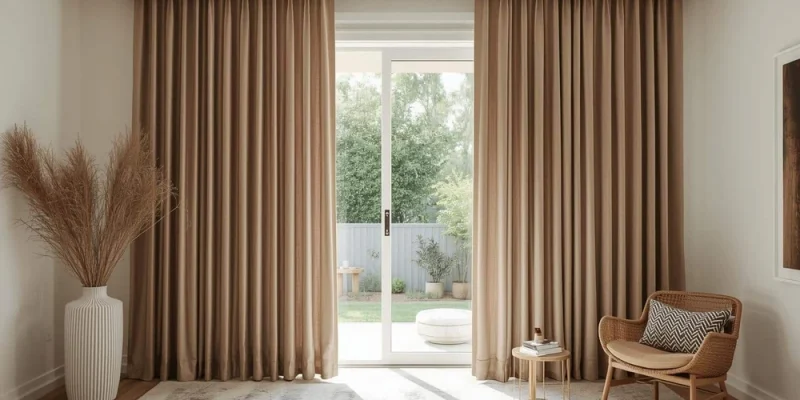
S wave curtains are the window treatment that contemporary Singapore interiors keep returning to, and the reason is visible the moment you see a well-executed installation. The continuous, even wave across the width of the curtain panel creates a visual quality that no other heading style replicates. It is elegant without being formal, structured without being rigid, and it makes the fabric itself the main event rather than a vehicle for a complicated pleat arrangement.
Understanding the S Wave Heading
The S wave heading, also called S fold, is produced by a specialised track system in which carriers are spaced at a fixed interval and connected by a cord or tape that holds each carrier in a precisely offset position from its neighbours. When fabric is attached to these carriers, it forms an alternating forward-and-back wave pattern – the S shape that gives the heading its name.
The wave pitch, which is the distance between the peaks of successive waves, determines how deep and prominent the wave appears. A tighter pitch of 60 to 70 millimetres creates a more subtle, layered effect. A wider pitch of 80 to 100 millimetres produces a more dramatic, deeply undulating wave. The optimal pitch for a given installation depends on the fabric weight, the panel width, and the visual effect desired.
What distinguishes S wave from other heading styles is the consistency of the wave pattern across the entire width of the fabric. Unlike pinch pleat headings where the arrangement can shift with use, the S wave track system holds the wave position mechanically. The curtain looks the same whether it was drawn open and closed yesterday or a month ago.
Why S Wave Works in Modern Singapore Homes
S wave curtains suit Singapore’s contemporary residential interior context for several reasons that go beyond aesthetic preference.
Singapore’s modern residential interiors, particularly in newer condominium developments, tend toward clean lines, open plan layouts, and large window expanses. In this context, window treatments that are visually busy or that draw attention through their heading complexity compete with the architecture. S wave curtains allow a large expanse of fabric to provide light management and privacy without the window treatment becoming the most prominent element in the room.
The heading also scales well to floor-to-ceiling applications, which are common in Singapore’s mid-range and premium condominiums. A floor-to-ceiling S wave curtain in a quality sheer fabric transforms the window wall into a light-diffusing element that makes the room feel taller and more refined.
Fabric and Colour Selection
The full potential of the S wave curtain style is realised through careful fabric selection. The wave requires a fabric that drapes well – that hangs in smooth folds under its own weight – rather than one that is too stiff to follow the track’s wave pattern or too light to hold a defined fold.
For living areas, sheer or semi-sheer fabrics in neutral tones – white, off-white, light grey, warm sand – create a soft ambient light quality while maintaining privacy at night with blackout or blockout layers behind. For bedrooms, blockout-lined S wave curtains in a fabric that coordinates with the room’s colour palette provide light exclusion with the aesthetic quality of a drapery-style installation.
As Singapore interior design consultant Patricia Wee, known for her work on several award-winning residential projects, has noted, “The S wave heading is forgiving in colour selection because the wave itself adds visual interest. You do not need a bold or complex fabric to achieve a distinguished result.”
Motorisation and Smart Home Integration
Motorised S wave curtains in Singapore are increasingly common in residential installations where the track system is extended with a compatible motor. Motorised S wave systems integrate with home automation platforms including Google Home, Amazon Alexa, and proprietary smart home systems, allowing the curtains to be operated by voice, smartphone, or automated schedule.
For large curtain panels or for tracks installed at heights that make manual operation inconvenient, motorisation adds meaningful daily convenience. The investment in motorisation is also typically more achievable when planned at the initial installation stage rather than retrofitted to an existing manual system.
Getting S Wave Right
S wave curtains for a contemporary home require a compatible track, appropriate fabric, and correct installation. The wave pitch, fabric fullness ratio, and track position relative to the ceiling and window all contribute to the final result. An installation where each of these elements is correctly specified produces one of the most consistently impressive window treatment outcomes available in Singapore’s residential market.




Comments